Update: Stuttgart Higher Regional Court Finds Trademark Infringement of the Square “Ritter SPORT” Shape Mark by the Packaging of a Square Oat Bar
Initially, the 17th Civil Chamber of the Stuttgart Regional Court had ruled in its judgment of January 13, 2026 (Case No. 17 O 192/25), that the trademark-protected square packaging shape of the “Ritter SPORT” chocolate bar was not infringed by the packaging of the square (cocoa) oat bar “MONNEMer QUADRAT” produced by a Mannheim-based manufacturer. However, the 2nd Civil Division of the Stuttgart Higher Regional Court, acting as the appellate court, took a different view in its judgment of November 5, 2026 (Case No. 2 U 3/26) and ruled that the packaging of the square oat bar does indeed infringe the square “Ritter SPORT” shape trademark.
The Division did not grant leave to appeal the ruling. However, the ruling is not yet final: there is still the possibility of filing a complaint against the denial of leave to appeal with the Federal Court of Justice (BGH). It therefore remains to be seen whether the BGH will also hear this case.
I. Background
The trademark DE No. 398699704 is a shape trademark owned by a company affiliated with the manufacturer of the “Ritter SPORT” chocolate bar. It protects a three-dimensional packaging structure with a square base featuring characteristic closure tabs with grooves and zigzag elements. The action was brought against the square oat bar “MONNEMer QUADRAT” produced by Wacker GmbH.
As with the first-instance ruling by the Regional Court of Stuttgart, the case once again did not concern the validity of the three-dimensional shape trademarks for the “Ritter SPORT” chocolate bar, which have already been the subject of multiple court proceedings (e.g., in: Federal Court of Justice, Case No. I ZB 42/19; I ZB 43/19, orders dated July 23, 2020), but rather raised questions regarding the enforceability of the shape trademark.
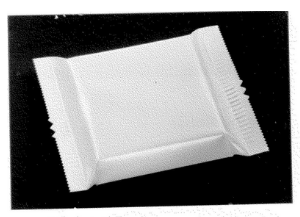
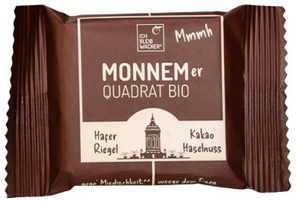
II. The First-Instance Decision of the Regional Court of Stuttgart
A brief summary of the first-instance judgment: The Regional Court of Stuttgart had already ruled out a sufficient degree of similarity between the goods to give rise to a likelihood of confusion, citing differences in main ingredients, placement on store shelves, and perception as a dessert/candy (chocolate bar) versus a functional energy snack with a “healthy” image (oat bar).
It also found that the marks were not sufficiently similar to give rise to a likelihood of confusion. The oat bar packaging appeared visually as a rectangle, not a square; it was taller/thicker and “lighter” with wider flaps. Furthermore, its embossing ran vertically rather than horizontally, and the zigzag pattern was more uniform and coarse.
The claim for protection based on reputation was also denied. The Mannheim-based company’s slogan "Quadratisch. Kokos. Klar." (en: Square. Coconut. Clear.) – presumably inspired by "Quadratisch. Praktisch. Good." (en: Square. Practical. Good.) from Ritter SPORT – was expressly disregarded in the proceedings as it may infringe another Ritter SPORT trademark but is not covered by the subject matter of the current proceedings.
Further details and background information on the Stuttgart Regional Court’s decision can be found in our blog post dated March 31, 2026.
III. The Decision of the Higher Regional Court of Stuttgart
Upon appeal, the 2nd Civil Division of the Stuttgart Higher Regional Court, in its judgment dated November 5, 2026 (Case No. 2 U 3/26), has now overturned the judgment of the Stuttgart Regional Court and granted the claim in its entirety. Specifically, it stated:
1. At least average similarity of goods
In contrast to the Stuttgart Regional Court, the Stuttgart Higher Regional Court affirmed at least an average similarity between the goods. Both chocolate bars and oat bars are foodstuffs – more specifically, sweet, ready-to-eat products consumed as a snack, source of energy, or simply for pleasure. The goods are therefore essentially interchangeable. The Higher Regional Court rejected the Regional Court’s classification of oat bars as a special health-oriented market distinct from chocolate bars, which primarily serve as desserts or sweets: The decisive factor is the mixed consumer, who consumes not only products advertised as healthy but also indulgence products such as chocolate bars. This overwhelming majority of consumers constitutes the average consumer, who must be taken as the benchmark in trademark law analysis. Furthermore, the boundaries between the goods are nearly fluid; there are chocolates on the market containing nuts and fruits, just as there are oat bars with chocolate coatings or chocolate chips. Finally, the Higher Regional Court of Stuttgart also did not consider the initially assumed differences in typical retail placement to be substantiated. On the contrary: The goods are not only offered online and in the same brick-and-mortar stores, but they are also regularly found in the same department and, here as well, frequently in close proximity to one another.
2. Above-Average Similarity of the Marks – Squaring the Rectangle
Also contrary to the Stuttgart Regional Court, the Stuttgart Higher Regional Court considered the marks to be above-average similar. Both packages are characterized by a pouch-like main component. The shape trademark is square, whereas the oat bar’s packaging – with an aspect ratio of approximately 6:7 – is, from a geometric perspective, actually a rectangle. However, because the longer edges are only about 1/6 longer than the shorter ones, the proximity to a square naturally suggests a mental association with the protected square shape.
In addition, the pressed side flaps of the oat bar packaging also increase the similarity. Despite differences in their embossing and in the size of the triangles along the edges, they reinforce the similarities between the two packaging shapes in the perception of the relevant public. The Stuttgart Higher Regional Court also does not share the impression, previously held by the Stuttgart Regional Court, that the packaging appears “airier” when viewed as a whole.
It is possible to create an overall impression through design that protects the consumer from the misconception regarding the origin of the goods that would result from viewing the shape in isolation. However, beyond a mere comparison of the packaging shape, the Stuttgart Higher Regional Court also denied that the graphic design features printed on the oat bar packaging set the product sufficiently apart from goods offered in the shape of the plaintiff’s trademark to eliminate similarity between the signs. Neither the stylized image of the Mannheim water tower, nor the imprint “MONNEMer Quadrat,” nor the imprints “Wacker,” “BLEIB WACKER,” or “ICH BLEIB WACKER” would be sufficient to achieve this. On the contrary: the square frame reproduced on the front of the packaging conveys a “square character” of the central body of the packaging, which increases the similarity to the plaintiff’s trademark. In an overall assessment, the defendant’s design choices outside the three-dimensional shape resulted in an even closer approximation to the plaintiff’s trademark rather than a clear differentiation from it.
3. Claim based on protection of reputation – “Quadratisch. Kokos. Klar.” underlines the exploitation of the pull effect of Ritter SPORT
Already in its assessment of the likelihood of confusion pursuant to Section 14(2)(2) of the German Trademark Act (MarkenG), the Higher Regional Court of Stuttgart assumed that the plaintiff’s trademark possessed a very high degree of distinctiveness, which was not diluted by other square-shaped confectionery products (such as “Romy”-chocolate or “Knoppers”), especially since such dilution would only be considered if the products were more similar to the plaintiff’s trademark than the contested oat bar. Based largely on the same reasoning, the court also affirmed protection based on reputation under Section 14(2)(3) of the German Trademark Act (MarkenG).
Due to its reputation, the shape mark exerts a significant pull effect, which the oat bar manufacturer had deliberately sought to capitalize on. The contested packaging bears an above-average resemblance to it and, for that reason alone, attracts attention that it would not otherwise receive. This is further reinforced by the graphic presentation. Furthermore, the advertising slogan “Square. Coconut. Clear,” which, in an allusion to “Square. Practical. Good,” directs thoughts even more specifically toward “Ritter SPORT”. The Stuttgart Regional Court had previously viewed the advertising slogan as not falling within the scope of the dispute; the Stuttgart Higher Regional Court now takes the slogan into account in its reasoning, since the plaintiff had already relied on the advertising campaign featuring “Quadratisch. Praktisch. Gut.” to substantiate its claims, and this submission had to be considered.
IV. Context and take aways
The Stuttgart Higher Regional Court’s assumption of at least an average similarity between a cocoa-oat bar and a chocolate bar appears – as already noted in the analysis of the Stuttgart Regional Court’s judgment – to be significantly more convincing than the assumption of such a low degree of similarity as assumed by the chamber of the Stuttgart Regional Court. The Stuttgart Higher Regional Court’s assessment also aligns with the decisions of the European Union Intellectual Property Office (EUIPO), even though European trademark decisions have no formal binding or indicative effect in national proceedings.
The examination of the similarity of the signs demonstrates – as does the judgment as a whole – that the courts may weigh the overall impression quite differently, and therefore it may be worthwhile to pursue a legal challenge against a first-instance judgment in trademark law. Whereas the Regional Court had emphasized the minor differences (proportions, embossed tabs), the Higher Regional Court now places greater weight on the overall impression. The public’s familiarity with multiple marking in the food and confectionery sectors also plays a role. If, as in the present case, the public is accustomed to manufacturers using multiple trademarks to identify their products and perceives the shape as an indication of origin, the mere addition of trademarks to the product may not be sufficient to eliminate the likelihood of confusion. Thus, in the present case, the marks used were not sufficient to prevent the public from continuing to view the shape as an indication of origin. In fact, through the use of the word “Quadrat” (eng: square), they even alluded to the protected shape rather than distancing the product from it. Although the Higher Regional Court’s ruling does not imply an unrestricted monopoly on the basic square shape on snack shelves, it does suggest that a detailed legal review is necessary before launching a new product.
Businesses planning to bring a new product to market also gain further valuable research insights from the ruling: Before market launch, it is advisable not only to search trademark registers for word marks or word-and-device marks that might be similar to one’s own, but also to specifically search for shape and color marks. Furthermore, the ruling shows that looking beyond one’s immediate category pays off: Particularly in the case of well-known trademarks with a broad reputation, the mere fact that the product belongs to a different product category is generally not sufficient to avoid infringement. A comprehensive trademark search can therefore significantly reduce legal risks under trademark law following a product launch.
As for advertising slogans: While drawing inspiration from well-known slogans may initially attract attention, it can sometimes reinforce the impression in court proceedings that one is unjustifiably capitalizing on the pull of a well-known trademark and should therefore be reviewed from a legal perspective in advance.
We will keep you updated on any further developments in this and similar cases on our blog.


You might also be interested in this
Obtaining trademark protection in 27 countries through a single application is one of the major advantages of the European Union trademark. But did you know that an EU trademark can also enable you to take action against trademark infringement in the Caribbean, off the coast of Africa or even in the Indian Ocean? And that, conversely, there are certain territories belonging to Member States of the European Union in which national trademarks of the respective Member State enjoy protection, whereas EU trademarks do not? These are compelling reasons to take a closer look at the world map, explore just how far the protection afforded by an EU trademark actually extends, and highlight the particularities you should bear in mind when developing your trademark strategy.
Following the Digital Services Act (DSA) and the Digital Markets Act (DMA), the EU Commission’s third major digital package is on the horizon: the Digital Fairness Act (DFA). On November 11, 2026, the EU Commission presented its proposal for a new reform package. With it, the European Commission intends to close regulatory gaps identified in its Digital Fairness Fitness Check, published in October 2024, regarding horizontal consumer law—specifically concerning dark patterns and addictive digital product designs. The responsible EU Commissioner, Michael McGrath, describes it as the most significant overhaul of European consumer protection law in over 20 years. Is it a blessing or a curse? In this blog post, we provide an overview of the planned regulations, place them within the context of existing national competition law, and offer concrete recommendations for practice.
Since 27 September 2026, stricter rules on unfair commercial practices introduced by the EU's Empowering Consumers for the Green Transition (EmpCo) Directive have applied in Germany. This raises a pressing question for manufacturers and retailers: What happens to products and packaging manufactured or placed on the market before that date which no longer comply with the new requirements? Can these stocks still be sold, or do businesses face injunctions, product recalls and, potentially, the destruction of perfectly usable goods?
On 17 September 2026, the First Board of Appeal of the EUIPO issued an interlocutory decision in KIRA (fig.) / QIRA (R-1989/2025-1) referring the case to the Grand Board of Appeal. At stake are two deceptively simple questions with potentially very large consequences: (1) is the term "software" clear and precise enough to serve as the basis for trade mark protection at all and (2), if so, is software similar to motor vehicles?