Three-dimensional shape trademarks in practice: Stuttgart Regional Court rejects claim that the packaging of a square oat bar infringes the square “Ritter SPORT” shape trademark
More specifically, it is the trademark-protected square packaging shape of Ritter SPORT chocolate bars that is causing the dispute. On 13 January 2026, the 17th Civil Chamber of the Stuttgart Regional Court ruled that the packaging of the square (cocoa) oat bar "MONNEMER QUADRAT" from a Mannheim-based manufacturer does not infringe this trademark.
An appeal against the decision has now been lodged with the Higher Regional Court of Stuttgart. This was announced by the plaintiff's representatives during the oral hearing. The case will therefore also be dealt with by the higher court(s).
I. Starting point
The trademark in question is a three-dimensional shape trademark belonging to a company associated with the manufacturer of Ritter Sport chocolate bars. It protects packaging with a square base and distinctive closure tabs with grooves and zigzag elements. The plaintiff sought an injunction against the oat bar manufacturer in particular, arguing that there was a likelihood of confusion and that the reputation of the trademark had to be protected.
II. The decision of the Regional Court of Stuttgart
The court dismissed the case. Specifically, the Regional Court of Stuttgart stated:
1. Insufficient similarity of goods
Although the Regional Court of Stuttgart did not assume that the goods are dissimilar, it denied that there was such a degree of similarity between the goods that a likelihood of confusion could be assumed. The average consumer primarily perceives chocolate bars as a classic dessert or sweet treat. On the other hand, the cocoa-hazelnut-oat bar, which the court categorized as a muesli bar, is viewed as a functional energy snack with a "healthy" image. Additionally, its main ingredients and typical store placement differ.
2. Insufficient similarity between the signs – comparison of the shapes as a comparison of details
The court also ruled that the marks were not similar enough to cause confusion. When comparing the packaging (without printing), the chamber emphasized as the main difference that the packaging of the oat bar at issue appeared visually as a rectangle and not as a square. Additionally, the oat bar's packaging was taller, thicker, and "more airy." The closure tabs were wider, and the embossing (grooves) of the side closure tabs were vertical instead of horizontal. The zigzag pattern of the side closure tabs was also more uniform and coarse compared to the trademark in question.
It was also noted that there are other square confectionery products on the market, so consumers do not necessarily equate every square with "Ritter SPORT."
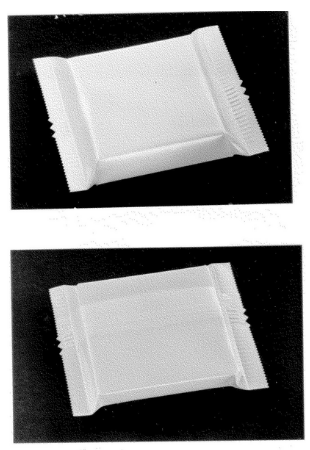
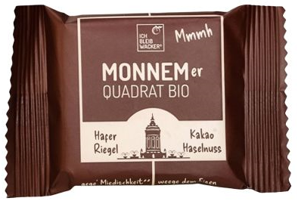
3. No claim based on protection of reputation – square does not automatically mean "Ritter SPORT"
The Regional Court of Stuttgart also rejected the claim for reputation-based protection. “Ritter SPORT” cited the advertising slogan "Quadratisch. Kokos. Klar." (en: Square. Coconut. Clear.) as evidence of a mental association. The Mannheim-based company had used this slogan to promote its oat bar and had presumably intended to deliberately create a mental association with the trademark in question. However, the slogan — presumably inspired by "Quadratisch. Praktisch. Good." (en: Square. Practical. Good.)” from Ritter SPORT — was expressly disregarded in the proceedings as it may infringe another Ritter SPORT trademark, but is not covered by the subject matter of the current proceedings.
The court dismissed any suggestion of a mental association between the plaintiff’s trademark and the oat bar among the relevant public, citing the aforementioned considerations regarding the differences between chocolate and granola bars. Consequently, it found no unfair exploitation or impairment of the distinctive character or reputation of the plaintiff’s trademark.
III. Context and take aways
The three-dimensional trademarks of the Ritter Sport chocolate bar have already been the subject of several court proceedings. In previous proceedings, the validity of the shape marks was primarily questioned (e.g., Federal Court of Justice, Ref. I ZB 42/19 and I ZB 43/19 on July 23, 2020), the current proceedings have raised questions regarding the enforceability of the trademarks.
It seems debatable whether the average consumer actually assumes such a low degree of similarity between a cocoa oat bar and a chocolate bar as the Stuttgart Regional Court did. After all, customers of the Mannheim-based oat bar manufacturer write in their reviews of a gift set of oat bars that the bars are a "delicious alternative to chocolate" or a "healthy, delicious alternative." These reviews therefore argue in favor of the substitutability of the products, suggesting a certain similarity between the goods.
However, the rejection of a sufficient similarity between the signs seems convincing. It highlights the limitations of protecting and enforcing three-dimensional shape marks with simple, basic shapes. In the case of "Ritter SPORT" chocolate bars in particular, this limited scope of protection is evident in supermarkets:
On the one hand, there are snacks that were already on the market before the shape trademark was registered, whose packaging may therefore continue to be square (in particular “Romy” chocolate, probably also “Knoppers”). On the other hand, there are court rulings such as the current one and previous ones (e.g. regarding a purple double pack of chocolate that could be divided into square halves: Higher Regional Court of Cologne, judgment of 30 March 2012, Case No. 6 U 159/11), which found no likelihood of confusion between certain snacks that entered the market after the shape trademark was registered and the “Ritter SPORT” shape trademarks. The combination of the market environment at the time of registration, the inherently limited scope of protection for three-dimensional trademarks with simple shapes, and established case law allows multiple square products on the market. Therefore, not every square snack package in and of itself infringes on the existing “Ritter SPORT” shape trademarks. A monopolization of the square shape on the snack shelf does not occur.
The current ruling demonstrates that, in cases involving simple shapes, individual circumstances and detailed comparisons are crucial. In addition to the packaged goods themselves, differences in packaging, such as flaps, embossing and proportions, can be crucial. These details can serve as evidence against trademark infringement in the event of a dispute.
We will keep you updated on further developments in this case and others like it on our blog.


You might also be interested in this
On 17 September 2026, the First Board of Appeal of the EUIPO issued an interlocutory decision in KIRA (fig.) / QIRA (R-1989/2025-1) referring the case to the Grand Board of Appeal. At stake are two deceptively simple questions with potentially very large consequences: (1) is the term "software" clear and precise enough to serve as the basis for trade mark protection at all and (2), if so, is software similar to motor vehicles?
In 2019, in an article for the Festschrift honoring Paul Ströbele, I examined how companies can defend themselves when their trademarks are used without consent as eye-catching vehicles for political messages.
OLG Bamberg, judgment of 29 July 2026 – 3 UKl 13/25 e | The Third Civil Senate of the OLG Bamberg continues to develop its Digital Services Act case law. For the first time, it specifies how far providers must disclose the weighting of their recommendation system parameters; at the same time, it prohibits login requirements as a precondition for reporting illegal content. We summarise the decision and provide guidance for practice.