Protecting Trademarks Against Political Fake Advertising: The CJEU on the “IKEA Plan”
For this phenomenon, I used the term “political fake advertising” (Goldmann, “Zum Schutz von Marken gegen Vereinnahmung durch politische Fake-Werbung” [“Protecting Trademarks Against Appropriation Through Political Fake Advertising”], in Hacker/Thiering (eds.), Festschrift für Paul Ströbele, 2019, pp. 67 et seq.).
This does not mean that the political message itself is untrue. Rather, the term describes political communication that appropriates the look and feel of another party’s trademark advertising and may thereby create the impression that the message originates with, or is at least endorsed by, the trademark owner.
In its judgment of September 8, 2026, in Case C‑298/23 – Inter IKEA Systems, the CJEU has now, for the first time, established an EU-law framework for balancing the competing interests. The judgment strengthens the protection of trademarks against political appropriation but leaves important questions concerning the cause of action under German law unresolved.
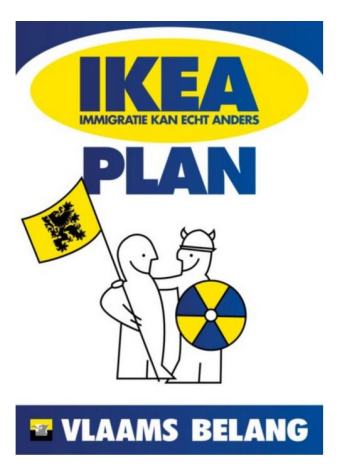
In brief: Freedom of expression may, in principle, justify the political use of another party’s trademark. But where the mark is appropriated merely as an attention-grabber, with no substantive connection to the message, and creates the impression of political endorsement, the CJEU’s judgment leaves little room for a finding of due cause. In Germany, the central unresolved issue is the applicable cause of action where the use falls outside the course of trade.
1. Vlaams Belang’s “IKEA Plan”
In 2022, the Belgian political party Vlaams Belang presented a program for reforming Belgium’s asylum and immigration policy under the name “IKEA-PLAN – Immigratie Kan Echt Anders.” Its political proposals were described as “ready to build” or “ready to assemble.” In doing so, the party used signs, colors, typefaces, and figures that clearly evoked IKEA’s trademarks and assembly instructions.
Inter IKEA Systems took action against the campaign. The competent court in Brussels asked the CJEU whether freedom of expression—including the freedom to express political opinions and engage in political parody—can constitute “due cause” for the use of another party’s trademark.
The Court’s answer is yes in principle: freedom of expression can constitute due cause. But it does not prevail merely because the trademark is used in a political campaign. Instead, it must be balanced against the trademark owner’s intellectual property, which is protected by Article 17(2) of the Charter of Fundamental Rights of the European Union (CJEU, Judgment of September 8, 2026 – C‑298/23, ECLI:EU:C:2026:721 – Inter IKEA Systems).
2. Political Fake Advertising, Not Trademark Parody
Both the question referred and the CJEU use the term “political parody.” As a characterization of the case at hand, however, that term captures the decisive point only imperfectly.
The “IKEA Plan” did not engage with IKEA, its products, its business practices, or its corporate policies. The trademark itself was not the subject of the political message. Rather, its reputation and distinctive advertising imagery were used to attract greater attention to, and amplify, a political message unrelated to IKEA.
This is precisely what may be described as political fake advertising: another party’s trademark, together with its corporate communications and corporate identity, is appropriated as an attention-grabbing vehicle for a political message. Viewers may at least be left with the impression that the trademark owner is associated with, approves of, or even supports the message.
The CJEU’s reasoning on the facts confirms this characterization. The Court stresses that the sole purpose of using the IKEA marks was to benefit from their reputation, reinforce the political message, and increase its dissemination (CJEU, cited above, para. 101). This is not an engagement with the mark; it is an exploitation of the mark’s communicative power for an unrelated political purpose.
3. Freedom of Expression May Constitute Due Cause
The legal starting points are Article 9(2)(c) of the EU Trade Mark Regulation and Article 10(2)(c) and (6) of the Trade Marks Directive. Under those provisions, the use of a sign identical or similar to a trademark with a reputation may be permissible if there is due cause for that use.
The CJEU makes clear that freedom of expression under Article 11 of the Charter of Fundamental Rights of the European Union can constitute due cause. Merely invoking freedom of expression is not enough. The user of another party’s trademark must explain the specific reasons for its use and demonstrate that its interest in conveying the message outweighs the trademark owner’s rights and interests.
For this balancing exercise, the Court identifies the following factors in particular:
- the purpose served by the use of the trademark and whether the user acted in good or bad faith;
- a substantive connection between the message and the mark, its owner, the owner’s business practices, goods, or services;
- the contribution of the expression to a debate of general interest;
- whether use of the mark is necessary for the particular expression, for example because of its linguistic meaning or because it has become a public cultural reference;
- the commercial or noncommercial context;
- the intensity, extent, and nature of the trademark use;
- the reputation of the mark and the degree of similarity between the signs;
- the consequences for the trademark owner and for the substance of the owner’s exclusive right;
- in particular, the risk of creating the impression that the trademark owner approves of or supports the political message.
Although the CJEU formally leaves the final assessment to the referring court, its guidance on the facts is unequivocal. “IKEA” has no linguistic meaning that made use of the sign necessary. Nor had the mark become part of everyday language or a public cultural reference. There was no substantive connection between asylum and immigration policy and IKEA. At the same time, the name, typography, color scheme, and other elements of IKEA’s communications were used extensively and repeatedly and disseminated online to a potentially unlimited audience.
In these circumstances, the CJEU considers that there is every indication that the user’s freedom of expression does not outweigh IKEA’s rights and interests.
4. The Deckmyn Criteria Do Not Carry Over to Trademark Law
Also notable is what the CJEU does not do.
For the copyright parody exception, the Court held in Deckmyn that a parody must evoke an existing work while being noticeably different from it and must constitute an expression of humor or mockery (CJEU, Judgment of September 3, 2014 – C‑201/13, ECLI:EU:C:2014:2132 – Deckmyn and Vrijheidsfonds).
Legal commentators had repeatedly proposed transferring this definition of parody to trademark law. Gietzelt/Grabrucker considered a comparable understanding necessary in trademark law because parody is an autonomous concept of EU law (MarkenR 2015, 333, 340). Ohly likewise described Deckmyn as an important guide to defining trademark parody and considered the definition developed there transferable, while also emphasizing that, because trademark law contains no specific parody exception, the precise categorization was ultimately not decisive (Ohly, GRUR 2024, 1275, 1276–77).
Advocate General Szpunar’s Opinion still expressly proposed applying the two Deckmyn criteria. In his view, the national court should determine whether the signs used were noticeably different from the IKEA marks and whether the design actually conveyed humor or mockery (Advocate General Szpunar, Opinion of November 13, 2025 – C‑298/23, ECLI:EU:C:2025:886, paras. 128–130 – Inter IKEA Systems).
The CJEU does not follow that approach. It does not define trademark parody and, more particularly, does not make the criteria developed in Deckmyn a prerequisite for due cause. In paragraph 88, it merely considers the potentially satirical character of the form of expression and describes parody as a form of satire. In paragraph 96, it assumes that the use might qualify as a “political parody” without examining the elements of that concept. In paragraph 97, the high degree of similarity—or even identity—between the signs is treated not as disqualifying, but as a factor in the subsequent balancing exercise.
Trademark law therefore has no threshold Deckmyn inquiry. The decisive question is not whether the use qualifies conceptually as parody, but what communicative purpose it serves and what effects it has on the mark and its owner. Conversely, even a “genuine” parody within the meaning of Deckmyn is not justified under trademark law for that reason alone.
5. The Company’s Interest in Political Neutrality
The CJEU attaches particular importance to the risk of apparent political endorsement. The assessment must expressly take into account whether the trademark use may create the impression that the trademark owner approves of or supports the political message, even though the owner’s values are based on political neutrality or are incompatible with that message (CJEU, cited above, paras. 93 and 99).
In doing so, the Court recognizes precisely the interest that stood at the heart of my 2019 article. Political fake advertising forces a company to take a position on a message it did not originate. If it remains silent, its silence may be understood as agreement. If it distances itself, it is drawn into the political debate against its will. Its trademark and corporate communications become a vehicle for someone else’s political position.
A comparable assessment can already be found in older German case law. In “Pack den Tiger in die Bürgerschaft” (“Put the Tiger into Parliament”), the Hamburg Higher Regional Court considered a political adaptation of the well-known advertising slogan “Pack den Tiger in den Tank” (“Put a Tiger in Your Tank”). The court emphasized that a company seeking customer relationships irrespective of the public’s political preferences has a compelling interest in not being identified with a particular political movement (Hamburg Higher Regional Court, Judgment of September 12, 1997 – 3 U 202/97 – Pack den Tiger in die Bürgerschaft).
The doctrinal basis of that older decision does not readily carry over to current law. Its central assessment, however, is expressly confirmed by the CJEU.
6. Louboutin/Van dermeersch: A Direct Precursor
The IKEA dispute is not entirely without precedent even in Belgium. In 2013, Christian Louboutin took action against a political campaign by Anke Van dermeersch, a Vlaams Belang politician. The campaign materials showed her legs and, with particular prominence, black Louboutin high heels with their characteristic red soles, which were protected as a position mark. The shoes served as an eye-catching device for a political message directed against “Islamization.”
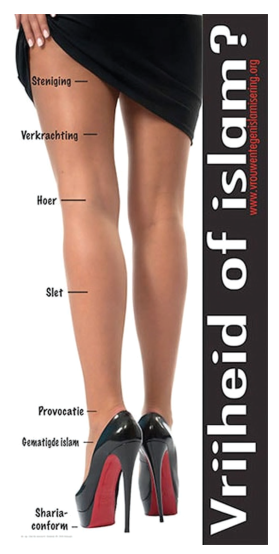
The Antwerp Commercial Court enjoined the use under Article 2.20(1)(d) of the then-applicable Benelux Convention. The red soles had been deployed so prominently that they drew substantially more attention to the poster than neutral shoes would have. Nor should Louboutin have to tolerate being associated with a controversial political campaign. There was no due cause for using the Louboutin mark in particular (Antwerp Commercial Court, Judgment of October 14, 2013 – C/13/00138 – Louboutin/Van dermeersch).
The case thus foreshadowed key elements of the CJEU’s present judgment: the mark as the dominant eye-catcher, the absence of any substantive connection to the political message, the exploitation of its attention-generating power, and the risk of an unwanted political association. For that reason, it already served as the starting point for my 2019 analysis of political fake advertising.
7. What Does the Judgment Mean for German Law?
Under German law, the central difficulty lies in identifying the applicable cause of action.
Where a trademark is used in the course of trade and in relation to goods or services, the protection afforded to trademarks with a reputation under section 14(2), first sentence, no. 3 of the German Trade Mark Act (MarkenG) may apply. The CJEU makes clear that even a nonprofit association may, in certain circumstances, act as an economic operator. Although a political program is, as such, neither a good nor a service, use of a trademark on promotional materials or in promotional online content may establish a sufficient link to goods or services (CJEU, cited above, paras. 50–55).
If, by contrast, the political use of a trademark is neither in the course of trade nor in relation to goods or services, the German Trade Mark Act (MarkenG) generally does not apply. Under the prevailing German view, this will ordinarily be the case (see, e.g., Hamburg Higher Regional Court, Judgment of September 12, 1997 – 3 U 202/97 – Pack den Tiger in die Bürgerschaft; Berlin Court of Appeal, Order of November 10, 2009 – 5 W 120/09 – Mitmachzentrum). Article 10(6) of the Trade Marks Directive permits Member States to provide protection against the use of a sign for purposes other than distinguishing goods or services. Unlike Benelux law, however, the German Trade Mark Act contains no specific provision for such cases where the unauthorized use occurs outside the course of trade.
This does not leave trademark owners in Germany without a remedy. Section 2 of the German Trade Mark Act (MarkenG) expressly preserves the application of other provisions. Possible bases for relief include in particular:
- section 12 of the German Civil Code (Bürgerliches Gesetzbuch, BGB)—the right to a name—if the trademark also functions as a name and qualifies for protection as such under the courts’ very broad interpretation of that concept;
- the German corporate personality right (Unternehmenspersönlichkeitsrecht), in conjunction with section 823(1) BGB and section 1004 BGB by analogy, particularly where the company is falsely associated with a political position and its autonomy over its corporate communications is impaired;
- in exceptional circumstances, section 826 BGB, which imposes liability for intentionally inflicting damage in a manner offending common decency.
When applying these open-ended civil-law provisions, courts must balance the competing fundamental-rights positions. The criteria now developed by the CJEU supply an EU-law framework for that exercise. Of particular importance are the absence of a connection between the mark and the political message, the intensity and reach of the use, the adoption of distinctive design elements, and the risk that political endorsement will be attributed to the company.
German constitutional law adds another dimension. According to the Federal Constitutional Court, freedom of expression is implicated where a person protected by fundamental rights is required to “disseminate another party’s opinion as its own,” or where the public is given the impression that a company supports another party’s statement of its own volition (Federal Constitutional Court, Order of January 22, 1997 – 2 BvR 1915/91, BVerfGE 95, 173, 182 – Tobacco Warning Labels). This is precisely one of the principal effects of political fake advertising: it first attributes another party’s political message to the trademark owner and then, as a practical matter, forces the owner to distance itself publicly from that message. The CJEU does not expressly characterize this interest as the trademark owner’s negative freedom of expression. By including the owner’s political neutrality and the risk of perceived endorsement in the balancing exercise, however, it captures the substance of the idea.
8. Article 10(6) of the Trade Marks Directive Does Not Require a Trademark with a Reputation
One aspect of the judgment calls for clarification. In paragraph 103, the CJEU describes Article 10(6) of the Trade Marks Directive as the basis for additional protection of national trademarks with a reputation. The text of the provision, however, does not require the mark to have a reputation.
This narrowing of the terminology is understandable in light of the main proceedings and the question referred, both of which concerned IKEA trademarks with a reputation. It must not, however, be understood as introducing an unwritten reputation threshold. In principle, Article 10(6) of the Trade Marks Directive also permits national protection for trademarks without a reputation, provided that use of the sign, without due cause, takes unfair advantage of, or is detrimental to, the distinctive character or repute of the trademark.
This matters for the German debate. Some older decisions made supplementary protection in tort dependent on the mark being known or even famous. Article 10(6) of the Trade Marks Directive provides no basis for any such general requirement.
9. Assessment and Outlook
The CJEU does not create a specific parody exception in trademark law. It does, however, recognize that freedom of expression may constitute due cause for the use of another party’s trademark and provides national courts with a nuanced framework for balancing the competing rights.
For political fake advertising, the direction is clear: where another party’s trademark is adopted without any substantive connection solely because its reputation and visual force lend additional attention to a political message, there is little basis for finding due cause. That is all the more so where the particular design may create the impression of approval or support by the trademark owner and impair the owner’s interest in political neutrality.
The judgment thus confirms key propositions developed in my 2019 article, “Zum Schutz von Marken gegen Vereinnahmung durch politische Fake-Werbung” (“Protecting Trademarks Against Appropriation Through Political Fake Advertising”) (Goldmann, in Festschrift für Ströbele, 2019, pp. 67 et seq.). What is new is the EU-law catalogue of factors by which the competing legal positions must now be balanced. How this standard is to be implemented in Germany through general civil-law causes of action warrants closer examination.
We advise companies on protecting their trademarks and corporate communications—including against political appropriation beyond the reach of traditional trademark law. If you have any questions, please contact us.


You might also be interested in this
Since 27 September 2026, stricter rules on unfair commercial practices introduced by the EU's Empowering Consumers for the Green Transition (EmpCo) Directive have applied in Germany. This raises a pressing question for manufacturers and retailers: What happens to products and packaging manufactured or placed on the market before that date which no longer comply with the new requirements? Can these stocks still be sold, or do businesses face injunctions, product recalls and, potentially, the destruction of perfectly usable goods?
On 17 September 2026, the First Board of Appeal of the EUIPO issued an interlocutory decision in KIRA (fig.) / QIRA (R-1989/2025-1) referring the case to the Grand Board of Appeal. At stake are two deceptively simple questions with potentially very large consequences: (1) is the term "software" clear and precise enough to serve as the basis for trade mark protection at all and (2), if so, is software similar to motor vehicles?
OLG Bamberg, judgment of 29 July 2026 – 3 UKl 13/25 e | The Third Civil Senate of the OLG Bamberg continues to develop its Digital Services Act case law. For the first time, it specifies how far providers must disclose the weighting of their recommendation system parameters; at the same time, it prohibits login requirements as a precondition for reporting illegal content. We summarise the decision and provide guidance for practice.