“Made with AI”? The New Labelling Obligation for AI Content from August 2026
1. What This Is About – and Who It Affects
In 2023, several images of Pope Francis wearing a white puffer jacket were posted on Reddit. Created with the AI software Midjourney, they went viral within hours, and many people took them for real, even though the technology was still in its infancy at the time. Generative AI has since made huge strides, not only in generating text but also in producing images and video. As a result, it is now widely used to create or edit content – including in advertising.
Article 50(4) of the AI Act addresses exactly this kind of content: anyone who uses artificial intelligence to generate or alter image, audio, or video content that qualifies as a “deepfake” must disclose that the content has been artificially generated or manipulated. The aim of the provision is to curb deception and disinformation arising from convincingly realistic synthetic content and to safeguard trust in media and advertising. The rule will apply directly in all Member States from 2 August 2026.
The obligation falls on the “deployer” of an AI system. Under Article 3(4) of the AI Act, this means any natural or legal person who uses an AI system under their own professional responsibility. That is a wide circle: advertising and creative agencies, in-house marketing departments, and publishers all fall within it, as do freelancers and influencers. The providers of the AI systems themselves, such as OpenAI or Adobe, are not covered – they are subject to separate, technical obligations of their own.
Anyone who fails to comply with the labelling obligation faces two separate sets of sanctions: the AI Act provides for substantial fines, and competitors or trade associations may also bring claims under unfair competition law. More on that below.
2. When Must Content Be Labelled? Three Steps to Identify a “Deepfake”
The labelling obligation is triggered whenever a “deepfake” is present. The term, however, must be understood far more broadly than it usually is in public debate, where it tends to be associated with politically motivated disinformation campaigns or fake celebrity videos.
The statutory definition in Article 3(60) of the AI Act can be broken down into three cumulative requirements:
- First, an AI system must have created or altered the content. Traditional retouching, conventional compositing, or pure CGI rendering without AI do not trigger the obligation, whereas generative tools such as Midjourney or “Generative Fill” in Photoshop do. What matters, then, is the use of AI, not image editing as such – even if the end result looks the same. In the abstract, however, drawing a clean line between AI-assisted editing and traditional “craft” editing is difficult, since conventional editing is increasingly AI-supported and the boundaries can blur.
- Second, the content must resemble real persons, objects, places, institutions, or events. This covers not just people but expressly also rooms, buildings, objects (such as products), or scenes (such as a street scene in a war zone). Contrary to what the wording might suggest, the subject does not actually have to exist; it is enough that the image looks realistic and could exist in reality (Commission draft guidelines, para. 107). Content that is recognisably stylised or physically impossible therefore falls outside the scope – though the counterexamples given in the draft guidelines are such clear-cut cases (for instance, an advertisement featuring mice arguing in human speech about the best type of cheese) that businesses should plan for an expansive reading of “realistic.”
- Third – and this is where the real distinction lies – the image must be capable of creating the impression in the viewer that it is a genuine, truthful depiction. The relevant standard is not an abstract average viewer but the actual, sometimes diverse audience exposed to the content, including groups with limited technical sophistication (draft guidelines, para. 108). Minor technical adjustments are not enough to meet this threshold: conventional editing techniques such as lighting and colour correction, noise reduction, or extending an image from portrait to landscape format do not amount to a deepfake even if carried out by AI (draft guidelines, para. 109). The position is different for interventions that change who or what is shown – for example, swapping a face or inserting an AI-generated person into a genuine photograph.
In simplified form, the assessment of whether a “deepfake” exists within the meaning of Article 50(4) of the AI Act can therefore be reduced to the following scheme:
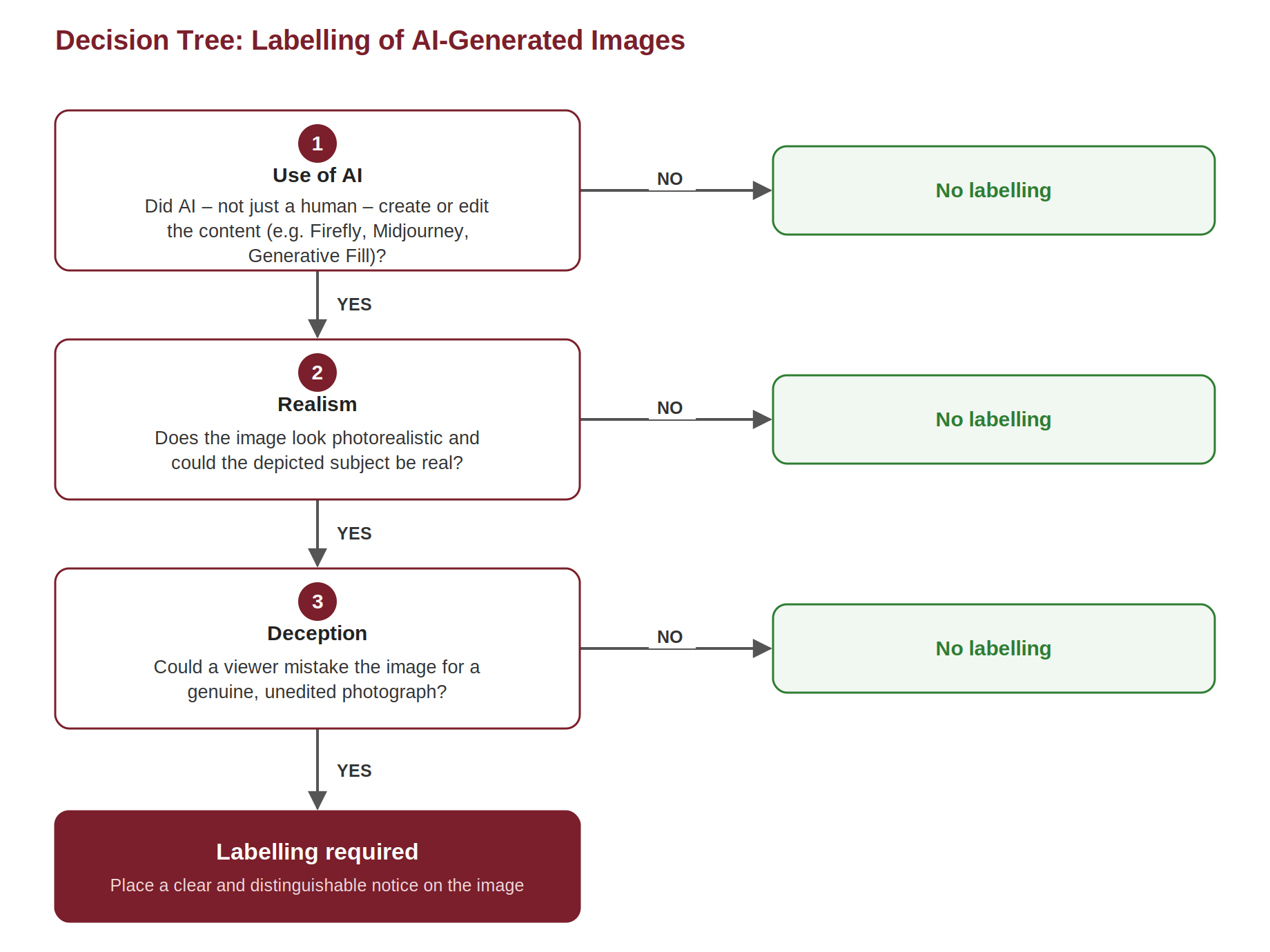
Simplified – not a substitute for an individual assessment
The relief provided for in the third sentence of Article 50(4) of the AI Act for evidently artistic, creative, or satirical works concerns only the manner of disclosure, and as a rule does not apply to clearly commercial advertising.
3. Typical Cases from Practice
For the most common scenarios in content production, this means:
- Face swap in a genuine photograph: labelling required if AI performs or assists the swap. Not required if the swap is done through traditional, manual retouching.
- AI-generated person or AI influencer in a real scene: labelling required. It makes no difference that the setting was created conventionally – it is enough that AI generated a relevant part of the image.
- Fully AI-generated product or environment shot: labelling required. The artificial creation of an entire, photorealistic scene is likely sufficient on its own.
- Extending the frame, a room, or a façade: generally not labelling-required, as the change is minor. The position may differ if the extension asserts something substantively new.
- Pure lighting or colour correction: not labelling-required.
One point beyond the AI Act is worth noting: if a business advertises using photorealistic product depictions that deviate from how the product actually looks, this alone can amount to misleading advertising about a material product feature under German unfair competition law (Section 5 UWG) – regardless of any AI labelling. Particular care is therefore warranted when advertising products with AI-generated imagery.
4. How Must the Label Be Displayed?
Under Article 50(5) of the AI Act, the label must be clear and distinguishable already at the first point of exposure to the content and must meet accessibility requirements. A notice placed only in the legal notice page or a separate, general list is therefore not enough – it belongs on the image itself. Information tucked away in a menu or a manual is precisely not “clear and distinguishable”.
Within this framework, there is room for choice in wording, placement, and design. The most practical approach is a caption above or below the image, such as “AI-generated” or “Edited with AI”; distinguishing between these depending on the nature of the intervention is a sensible approach. A recognisable watermark is likewise permissible.
More concrete guidance comes from the final Code of Practice on the labelling of AI-generated content of 10 June 2026. Compliance with it is voluntary and does not replace an assessment of the individual case; nonetheless, it is likely to become the de facto benchmark for when a label is “clear and distinguishable.” For the first time, the Code provides concrete EU icons that may be used freely and without attribution. Each is built around the letters “AI”: a basic icon suited to custom wording or an interactive second layer of information, and two further variants marking content that is either fully generated or subsequently edited. According to the user testing cited in the Code, a clear accompanying text considerably improves comprehension:

The abbreviation “AI” is in English. For the German market, it will likely be advisable to supplement it with a German-language notice, or to use one directly instead. The label is placed directly on the image – for example, in a corner – clearly set apart and recognisable against any background. Wherever possible, it should travel with the content across all distribution channels, remaining visible even after the content has been shared or downloaded. For videos and livestreams, the notice must appear at the outset and at regular intervals; for audio-only content, an audible notice is required.
Accessibility must also be considered: accompanying text should be written in plain language free of jargon, and the icon should be recognisable to assistive technologies through alt text. The use of the EU icons is, moreover, voluntary and does not in itself establish legal compliance; companies that have not signed the Code of Practice must also take care that their use of the icons does not create the impression that they have done so.
5. What Are the Consequences of Non-Compliance?
Breaches of the transparency obligation are sanctioned twice over. Article 99(4) of the AI Act provides for fines of up to EUR 15 million or 3% of worldwide annual turnover. The rule is enforced at EU level by the AI Office and, in Germany, by the Federal Network Agency (Bundesnetzagentur). In addition, claims for injunctive relief under unfair competition law may arise: Article 50(4) of the AI Act is likely to qualify as a market conduct rule under Section 3a UWG, making it enforceable privately by competitors and trade associations. The German Agency to Combat Unfair Competition (Wettbewerbszentrale) for instance, has already announced that it intends to pursue breaches of the labelling obligation.
One practical question remains unresolved and is likely to grow in importance: how does a claimant actually prove that unlabelled content was AI-generated in the first place? With depictions of people, this can often still be inferred today, for example from visible anomalies such as an incorrect number of fingers. With objects or rooms, proof is already frequently difficult to obtain – and as the technology advances, it is likely to become harder still. How enforcement will develop in this respect remains to be seen.
6. Practical Recommendations
A notice that a depiction is AI-generated or AI-manipulated is likely to trigger a degree of baseline scepticism toward the advertised product among consumers. Studies show that otherwise identical advertisements perform worse once they are labelled as AI-generated. Anyone seeking to use generative AI in a commercially sensible way should factor in this effect from the outset – for instance, through a notice that is unobtrusive yet legally sound.
Businesses using generative AI in content production should, in good time before 2 August 2026:
- map out where AI is used to generate or alter images, videos, or text;
- establish a labelling routine that, from an advertiser’s perspective, distinguishes between “AI-generated” and “Edited with AI”;
- place the notice on the content itself, in German;
- use the EU icons that fit the relevant format;
- for photorealistic product depictions, also keep the unfair competition law dimension (Section 5 UWG) in view;
- monitor the Commission’s final guidelines, which are expected before the obligation takes effect.
We are happy to advise you on questions relating to AI labelling as well as advertising and unfair competition law.


You might also be interested in this
On 17 September 2026, the First Board of Appeal of the EUIPO issued an interlocutory decision in KIRA (fig.) / QIRA (R-1989/2025-1) referring the case to the Grand Board of Appeal. At stake are two deceptively simple questions with potentially very large consequences: (1) is the term "software" clear and precise enough to serve as the basis for trade mark protection at all and (2), if so, is software similar to motor vehicles?
In 2019, in an article for the Festschrift honoring Paul Ströbele, I examined how companies can defend themselves when their trademarks are used without consent as eye-catching vehicles for political messages.
OLG Bamberg, judgment of 29 July 2026 – 3 UKl 13/25 e | The Third Civil Senate of the OLG Bamberg continues to develop its Digital Services Act case law. For the first time, it specifies how far providers must disclose the weighting of their recommendation system parameters; at the same time, it prohibits login requirements as a precondition for reporting illegal content. We summarise the decision and provide guidance for practice.